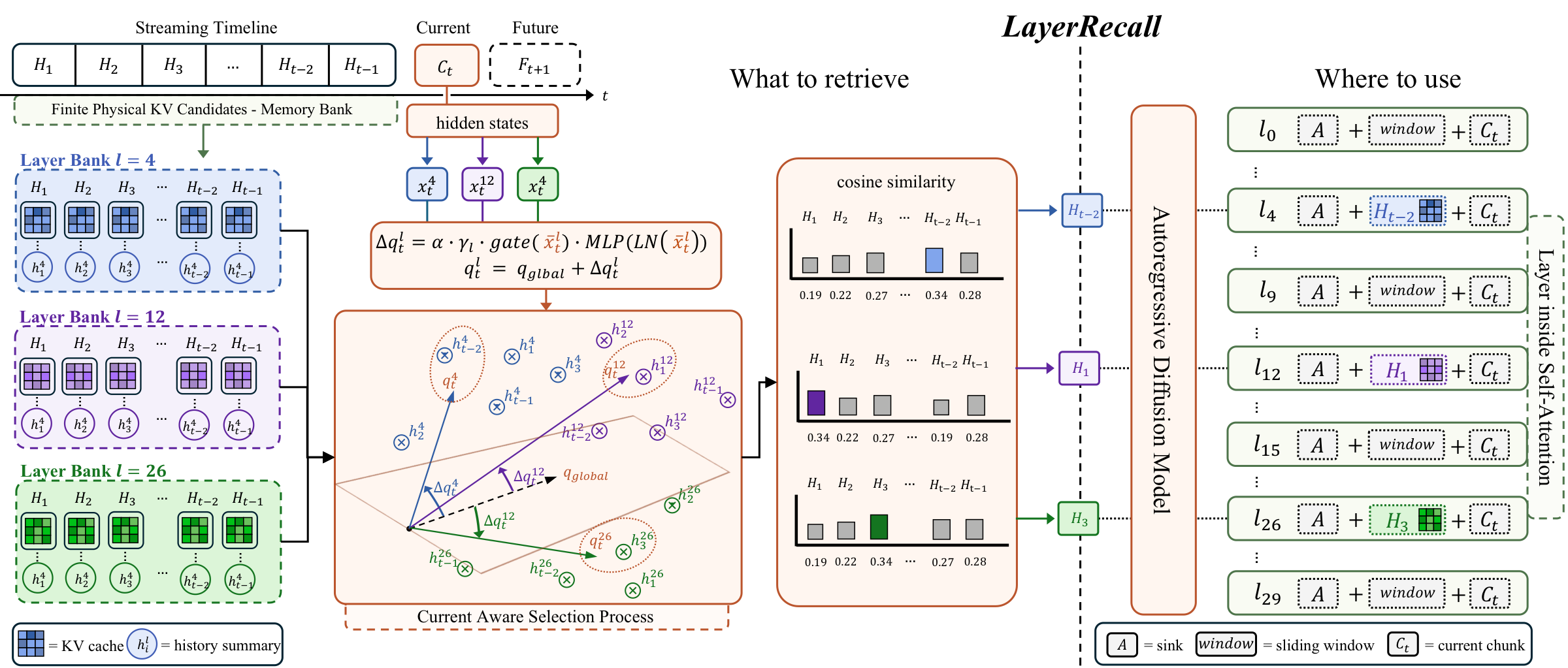
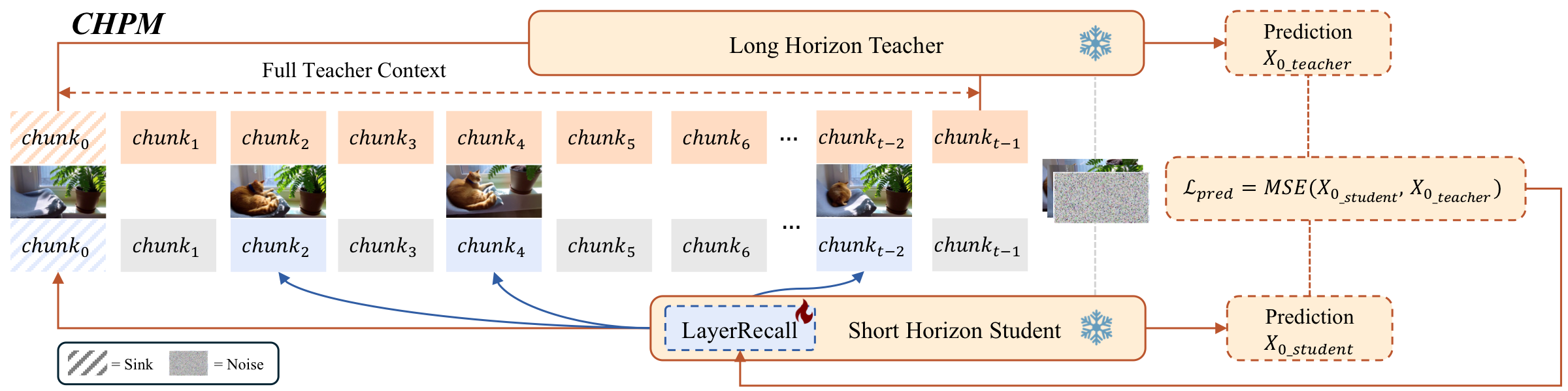
Autoregressive video diffusion enables scalable long-video generation by producing chunks from a bounded recent context, but recency-based caching eventually evicts the historical cues needed when subjects, objects, scenes, or attributes reappear. LayerRecall addresses this limitation with a current-conditioned, layer-selective memory router that retrieves relevant historical K/V states and injects them only into backbone-specific memory-sensitive layers while preserving local attention elsewhere. To reduce reliance on scarce high-quality long-horizon videos and explicit memory-allocation labels, CHPM uses a privileged long-context reference to supervise the bounded-memory router in prediction space. Across 100 multi-shot evaluation prompts, LayerRecall achieves the best overall results on MemoBench and MovieBench while matching its backbone on VBench-Long, strengthening long-range recovery without sacrificing local continuity; additional analyses show cross-backbone portability and negligible inference overhead.
01
PART 01
Long-Horizon Consistency Showcases
10 SHOWCASES · THREE-SHOT RECALL
LayerRecall improves long-horizon consistency by recovering subjects, attributes, and scene-specific cues after they leave the local context and later reappear.
Each 63.9-second showcase follows a controlled three-shot recall sequence: Shot 1 (00:00.0–00:31.9) establishes the subject and memory-critical visual cues; Shot 2 (00:31.9–00:47.9) moves the subject out of frame, creating a need for nonlocal memory; and Shot 3 (00:47.9–01:03.9) tests whether those earlier identity, attribute, and scene cues are faithfully recalled after the temporal gap. Because Shot 1 spans twice as much source time as either later shot, it plays at 2× while Shots 2 and 3 remain at 1×.
SHOWCASE 01
Morning Puppet Maker
An older puppet maker animates a large cloth puppet at his worktable, disappears behind the small stage curtain, then returns from behind it and settles at the table.
MEMORY CUE
Target identity and attributes
2×
SHOT 01
MEMORY GAP
Intended exit and off-screen interval
1×
SHOT 02
RECALL TEST
Long-range return after the gap
1×
SHOT 03
SYNCHRONIZED SHOT POSITION
LOADING 00/03
SHOWCASE 02
Stained-Glass Reader
An older reader turns the pages of an illustrated book beside a stained-glass window, walks out through the reading-room doorway, then returns to the same armchair.
MEMORY CUE
Target identity and attributes
2×
SHOT 01
MEMORY GAP
Intended exit and off-screen interval
1×
SHOT 02
RECALL TEST
Long-range return after the gap
1×
SHOT 03
SYNCHRONIZED SHOT POSITION
LOADING 00/03
SHOWCASE 03
Twilight Lighthouse Keeper
An older lighthouse keeper polishes the Fresnel lens, walks out through the narrow lantern-room doorway, then returns through the same doorway and settles beside the lens.
MEMORY CUE
Target identity and attributes
2×
SHOT 01
MEMORY GAP
Intended exit and off-screen interval
1×
SHOT 02
RECALL TEST
Long-range return after the gap
1×
SHOT 03
SYNCHRONIZED SHOT POSITION
LOADING 00/03
SHOWCASE 04
Cake Studio Decorator
A young cake decorator pipes frosting at a marble counter, exits through the cooler-room doorway, then returns to the same counter beside the unfinished cake.
MEMORY CUE
Target identity and attributes
2×
SHOT 01
MEMORY GAP
Intended exit and off-screen interval
1×
SHOT 02
RECALL TEST
Long-range return after the gap
1×
SHOT 03
SYNCHRONIZED SHOT POSITION
LOADING 00/03
SHOWCASE 05
Seaside Watercolorist
An older watercolorist paints at a seaside drawing board, leaves through the terrace doorway, then returns through the same doorway and settles beside the board.
MEMORY CUE
Target identity and attributes
2×
SHOT 01
MEMORY GAP
Intended exit and off-screen interval
1×
SHOT 02
RECALL TEST
Long-range return after the gap
1×
SHOT 03
SYNCHRONIZED SHOT POSITION
LOADING 00/03
SHOWCASE 06
Country Kitchen Pastry Chef
An older pastry chef kneads dough at a flour-dusted counter, leaves through the pantry doorway, then returns and settles at the same work position.
MEMORY CUE
Target identity and attributes
2×
SHOT 01
MEMORY GAP
Intended exit and off-screen interval
1×
SHOT 02
RECALL TEST
Long-range return after the gap
1×
SHOT 03
SYNCHRONIZED SHOT POSITION
LOADING 00/03
SHOWCASE 07
Vintage Tailor Shop
An older tailor guides fabric through a sewing machine, walks out through the tailor-shop doorway, then returns to the sewing table beside the arched window.
MEMORY CUE
Target identity and attributes
2×
SHOT 01
MEMORY GAP
Intended exit and off-screen interval
1×
SHOT 02
RECALL TEST
Long-range return after the gap
1×
SHOT 03
SYNCHRONIZED SHOT POSITION
LOADING 00/03
SHOWCASE 08
Candlelit Percussionist
A young percussionist taps a large drum in a candlelit rehearsal room, exits through the doorway, then returns and settles at the same drum.
MEMORY CUE
Target identity and attributes
2×
SHOT 01
MEMORY GAP
Intended exit and off-screen interval
1×
SHOT 02
RECALL TEST
Long-range return after the gap
1×
SHOT 03
SYNCHRONIZED SHOT POSITION
LOADING 00/03
SHOWCASE 09
Courtyard Bonsai Gardener
An older bonsai gardener trims a large bonsai at a courtyard stone table, exits through the courtyard gate, then returns and settles at the same table.
MEMORY CUE
Target identity and attributes
2×
SHOT 01
MEMORY GAP
Intended exit and off-screen interval
1×
SHOT 02
RECALL TEST
Long-range return after the gap
1×
SHOT 03
SYNCHRONIZED SHOT POSITION
LOADING 00/03
SHOWCASE 10
Paper Craft Studio
A young paper artist folds a large square sheet at a studio table, leaves through the paper-studio doorway, then returns to the same workstation.
MEMORY CUE
Target identity and attributes
2×
SHOT 01
MEMORY GAP
Intended exit and off-screen interval
1×
SHOT 02
RECALL TEST
Long-range return after the gap
1×
SHOT 03
SYNCHRONIZED SHOT POSITION
LOADING 00/03
02
PART 02
Memory-Guided Self Correction
DYNAMIC RETRIEVAL · LOCAL RECOVERY
In the annotated sequence, the man first returns with a light-blue collared shirt that conflicts with the burgundy crew-neck T-shirt established before he leaves. Moments later, the burgundy color and round neckline recover, and he remains at the library desk for the rest of the sequence.
The orange MISMATCH inset marks the drift; the green MATCH inset marks the recovery.
LayerRecall can revisit more detailed historical evidence as the returning subject becomes easier to identify. At first, the returning figure is still visually ambiguous. As his identity, silhouette, and relationship to the scene become clearer, the current-conditioned query can favor the earlier memory that best matches his appearance.
That memory is introduced only into memory-sensitive layers—the layers most responsive to long-range appearance cues—while the remaining layers support local motion and scene generation. This division is designed to help recover appearance details without applying historical memory to every layer.
INTERPRETATION · The sequence shows appearance recovery, not proof of the retrieval mechanism or uninterrupted motion. A pose change accompanies recovery; before/after selection logs would provide stronger mechanism-level confirmation.
VISUAL TRACE
Mismatch to recovery
ANNOTATED THREE-SHOT SEQUENCE · 21.96S
ORANGE: MISMATCH · GREEN: MATCH03
PART 03
Comparisons
5 CASES · LAYERRECALL + 2 BASELINES
On 60-second videos, we compare LayerRecall with mainstream open-source long-video generation models under a controlled present–absent–return setting: a subject is introduced, moves out of view, and must be recalled after the intervening scene.
LayerRecall more consistently restores the earlier subject and visual attributes while preserving overall temporal continuity and following the requested leave-and-return structure. Some baselines do not fully execute the departure instruction, so the intended memory gap is never established. For models without native multi-shot prompt input, we adapt the prompts to their supported format; full details are provided in the supplementary material.
CMP-01
Jazz-Club Pianist
Pianist on a small jazz-club stage · exits through the side-stage opening · returns to the piano
01 / 05
SYNCHRONIZED SHOT POSITION
LOADING 00/09
01
LayerRecall
OURS
MEMORY CUE
Target identity and attributes
2×
SHOT 01
MEMORY GAP
Intended exit and off-screen interval
1×
SHOT 02
RECALL TEST
Long-range return after the gap
1×
SHOT 03
02
LongLive
OPEN SOURCE
MEMORY CUE
Target identity and attributes
2×
SHOT 01
MEMORY GAP
Intended exit and off-screen interval
1×
SHOT 02
RECALL TEST
Long-range return after the gap
1×
SHOT 03
03
MemFlow
OPEN SOURCE
MEMORY CUE
Target identity and attributes
2×
SHOT 01
MEMORY GAP
Intended exit and off-screen interval
1×
SHOT 02
RECALL TEST
Long-range return after the gap
1×
SHOT 03
04
PART 04
Ablations
3 STUDIES · MEMORY QUALITY + TEMPORAL STABILITY
This section presents three ablation studies that isolate CHPM supervision, layer-selective memory routing, and profile-guided where-to-use, clarifying how each design choice contributes to memory quality and temporal stability.
04—A
Effect of CHPM
02 CASES · TRAINED VS RANDOM INIT
Across the 100-prompt evaluation set, with the same ten memory-sensitive layers, CHPM-trained routing raises MemoBench overall from 0.519 to 0.548 over randomly initialized routing and improves every reported subdimension. The gains support prediction matching as effective routing supervision beyond the fixed layer policy.
CHPM-01
Museum Relief Restorer
Stone-relief restorer beside a large museum relief · exits through the restoration-room doorway · returns beside the relief
01 / 02
SYNCHRONIZED SHOT POSITION
LOADING 00/06
01
LayerRecall Trained
OURS
MEMORY CUE
Target identity and attributes
2×
SHOT 01
MEMORY GAP
Intended exit and off-screen interval
1×
SHOT 02
RECALL TEST
Long-range return after the gap
1×
SHOT 03
02
LayerRecall Random Init
ABLATION
MEMORY CUE
Target identity and attributes
2×
SHOT 01
MEMORY GAP
Intended exit and off-screen interval
1×
SHOT 02
RECALL TEST
Long-range return after the gap
1×
SHOT 03
04—B
Effect of Layer-Selective Memory Routing
01 CASE · SELECTIVE VS ALL-LAYER ROUTING
Across the 100-prompt evaluation set, with the checkpoint, retrieved memory, memory budget, and evaluation protocol fixed, layer-selective routing reduces high-frequency frame-change power from 0.60 to 0.38 relative to all-layer routing. It also improves motion smoothness and adjacent-frame CLIP/DINO consistency, showing that targeted memory access limits temporal disturbance.
SYNCHRONIZED SHOT POSITION
LOADING 00/06
01
LayerRecall
OURS
MEMORY CUE
Target identity and attributes
2×
SHOT 01
MEMORY GAP
Intended exit and off-screen interval
1×
SHOT 02
RECALL TEST
Long-range return after the gap
1×
SHOT 03
02
All-Layer Routing
ABLATION
MEMORY CUE
Target identity and attributes
2×
SHOT 01
MEMORY GAP
Intended exit and off-screen interval
1×
SHOT 02
RECALL TEST
Long-range return after the gap
1×
SHOT 03
03
Abrupt-change energy
SHARED AXIS
LayerRecallAll-Layer Routing
0.04sLayerRecall 0.00000All-Layer Routing 0.00000
Lower abrupt-change energy indicates fewer sudden frame transitions; the shared axis exposes when broad all-layer memory access introduces temporal disturbance.
04—C
Effect of Profile-Guided Where-to-Use
02 CASES · PROFILED-10 VS RANDOM-10
Across the 100-prompt evaluation set, with the checkpoint, retrieval mechanism, and memory budget fixed, the profiled ten-layer policy raises MemoBench overall from 0.538 to 0.570 and improves four of five reported dimensions over an equally sized random policy. This matched comparison shows that where retrieved memory enters the DiT materially affects how well it is used.
LAYER-01
Copper-Lit Leather Artisan
Leather artisan at a long workbench · exits through the workshop doorway · returns to the bench
LayerRecall separates long-horizon memory into two decisions. A current-conditioned router selects relevant historical K/V states from finite, layer-indexed memory banks; only profiled memory-sensitive layers receive the retrieved states, while all other layers preserve the backbone’s original local attention context.
CHPM trains LayerRecall by matching predictions from two frozen views of the same backbone. The long-horizon teacher sees expanded historical context; the short-horizon student sees bounded local context augmented by LayerRecall memory routing. Only the routing module is optimized.
06
PART 06
Citation
BIBTEX · CONTACT
If you find this work useful, please consider citing:
@misc{ding2026layerrecallstateconditionedmemoryrouter,
  title={LayerRecall: A State-Conditioned Memory Router for Long-Horizon Consistency in Video Generation},
  author={Yixuan Ding and Jiahao Kong and Wei Huang and Ruijie Quan and Yi Yang},
  year={2026},
  eprint={2608.28460},
  archivePrefix={arXiv},
  primaryClass={cs.CV},
  url={https://arxiv.org/abs/2608.28460},
}